 Newsletters
 Contact us
- Crystal Devices
What Exactly Is Oscillator Jitter? (Part 2)

In this segment, we will define "oscillator jitter," a term that emerges during the evaluation of ICs and the design of circuits.
Jitter Items
There are several methods for measuring jitter, and there are also various jitter parameters.
In this segment, we will delve into the intricacies of representative jitter parameters.
For information on jitter measurement methods, please refer to Part 1.
Typical Measurement Areas and Jitter Items
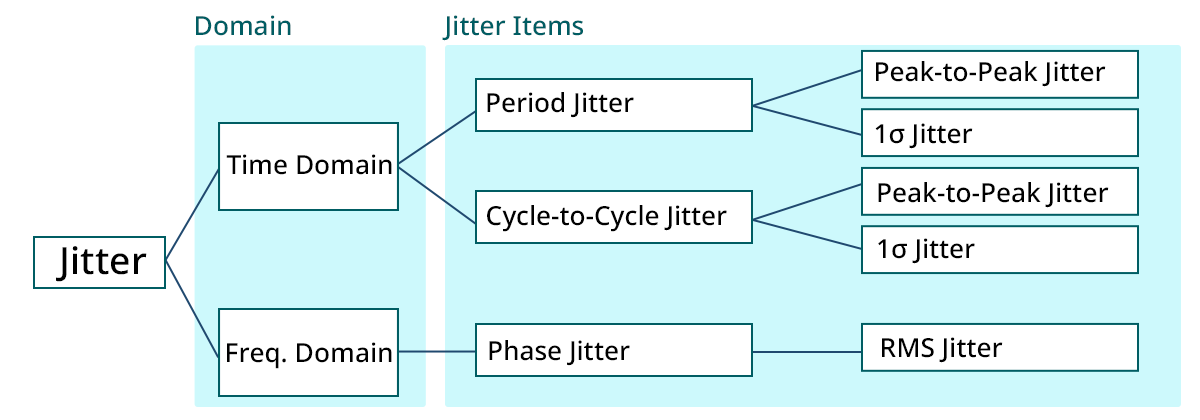
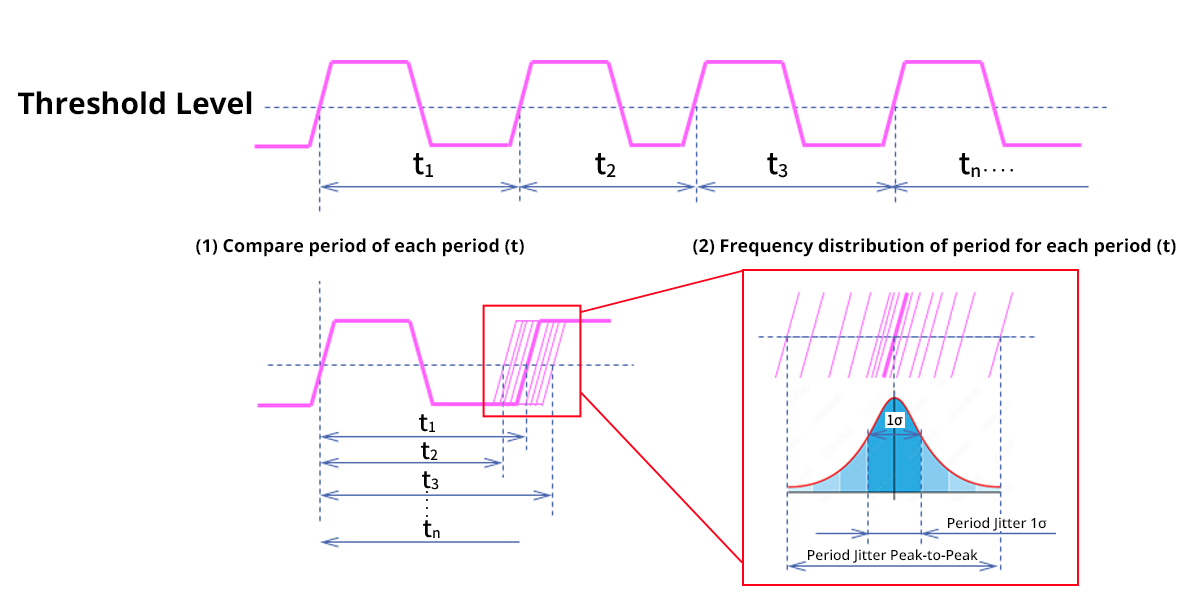
Period Jitter
This indicates the time deviation of one cycle (period) of the output waveform. When presenting measurement results, the following expression is commonly used.
Peak-to-Peak Jitter | The difference between the maximum and minimum values when statistically processing the time of one cycle at a specified threshold using frequency distribution. |
|---|---|
1σ Jitter | The standard deviation (1σ) when statistically processing (frequency distribution) the time of one cycle at a specified threshold. |
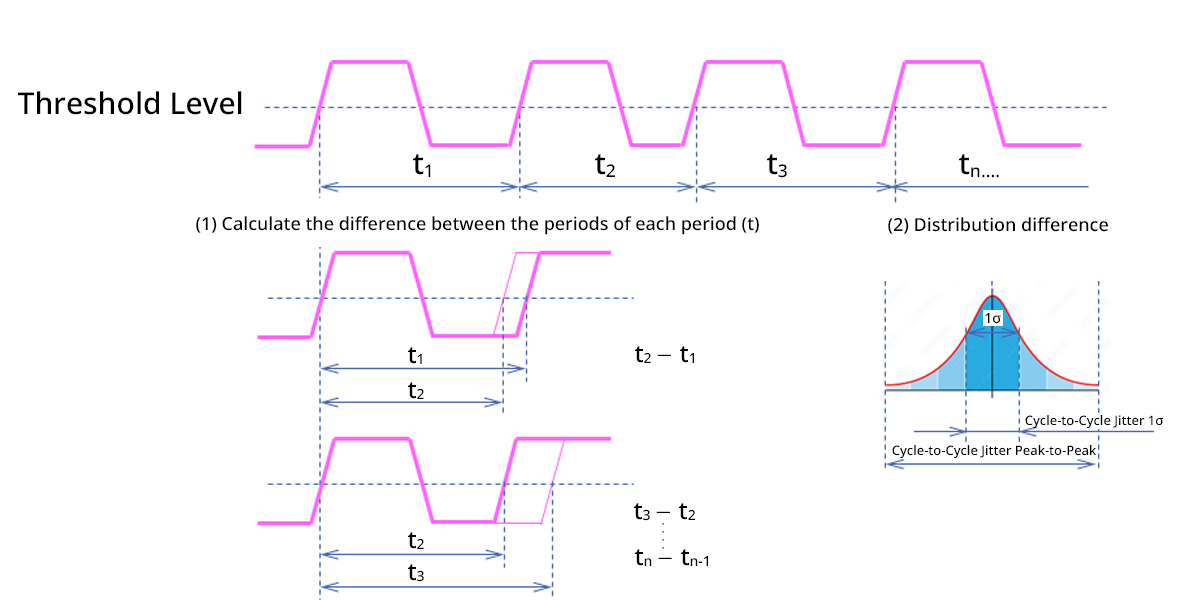
Cycle-to-Cycle Jitter
The time difference between one period of the output waveform and the time of the adjacent period. When presenting measurement results, the following expression is commonly used.
Peak-to-Peak Jitter | The difference between the maximum and minimum values of the time difference between one cycle and the next cycle when statistically processing (frequency distribution) at a specified threshold. |
|---|---|
1σ Jitter | The standard deviation (1σ) when statistically processing (frequency distribution) the difference between the time of one cycle and the next cycle at a specified threshold. |
Differences in Results Between Jitter Measuring Instruments
We explained that there are various measurement methods and metrics for jitter, but here we show the results of observing the same device unit and the differences in those numbers.
Article to be measured: CMOS output, clock oscillator, KC7050A125.000C30E00
Measurement environment: ambient temperature, humidity, supply voltage 3.3 V
Measuring Instrument | Domain | Measurement Item (1) and Results | Measurement Item (2) and Results | Measurement Condition | ||
|---|---|---|---|---|---|---|
Time Interval Analyzer (TIA) | Time Domain | Period Jitter/ | 17.79ps | Period Jitter/ | 2.25ps | 50,000cyc Hits or more |
Cycle-to-Cycle Jitter/ | 54.70ps | Cycle-to-Cycle Jitter/ | 3.51ps | |||
Digital Storage Oscilloscope (DSO) | Time Domain | Period Jitter/ | 29.75ps | Period Jitter/ | 3.13ps | 50,000cyc Hits or more |
Signal Source Analyzer(SSA) | Freq.Domain | Phase Jitter | 0.85ps | -- | -- | BW:12kHz to 20MHz |
While "jitter" is a general term, it varies depending on the measurement parameters and equipment used, so caution is required.
We can propose jitter specifications tailored to your requirements. Please contact us below for further information.

List of Basic Knowledge About Timing Devices Articles
vol.1 What is Crystal Unit Matching?
vol.2 What Are the Equivalent Circuit Constants of a Crystal Unit?
vol.3 What Exactly Is Oscillator Jitter? (Part 1)
vol.4 What Exactly Is Oscillator Jitter? (Part 2)
The Important Information/Disclaimer is incorporated in the catalog and/or this page by reference and should be reviewed in full before placing any order or inquiry.
Related Keywords
Technical information View All

 Contact & Support


Search by part number
Search by keyword
Search by category
-
- SAW Devices
- Advanced KYOCERA AVX Components
Search by Applications
Distributor Inventory Search
Please enter the model name of Kyocera. You can search up to 3 types at the same time.